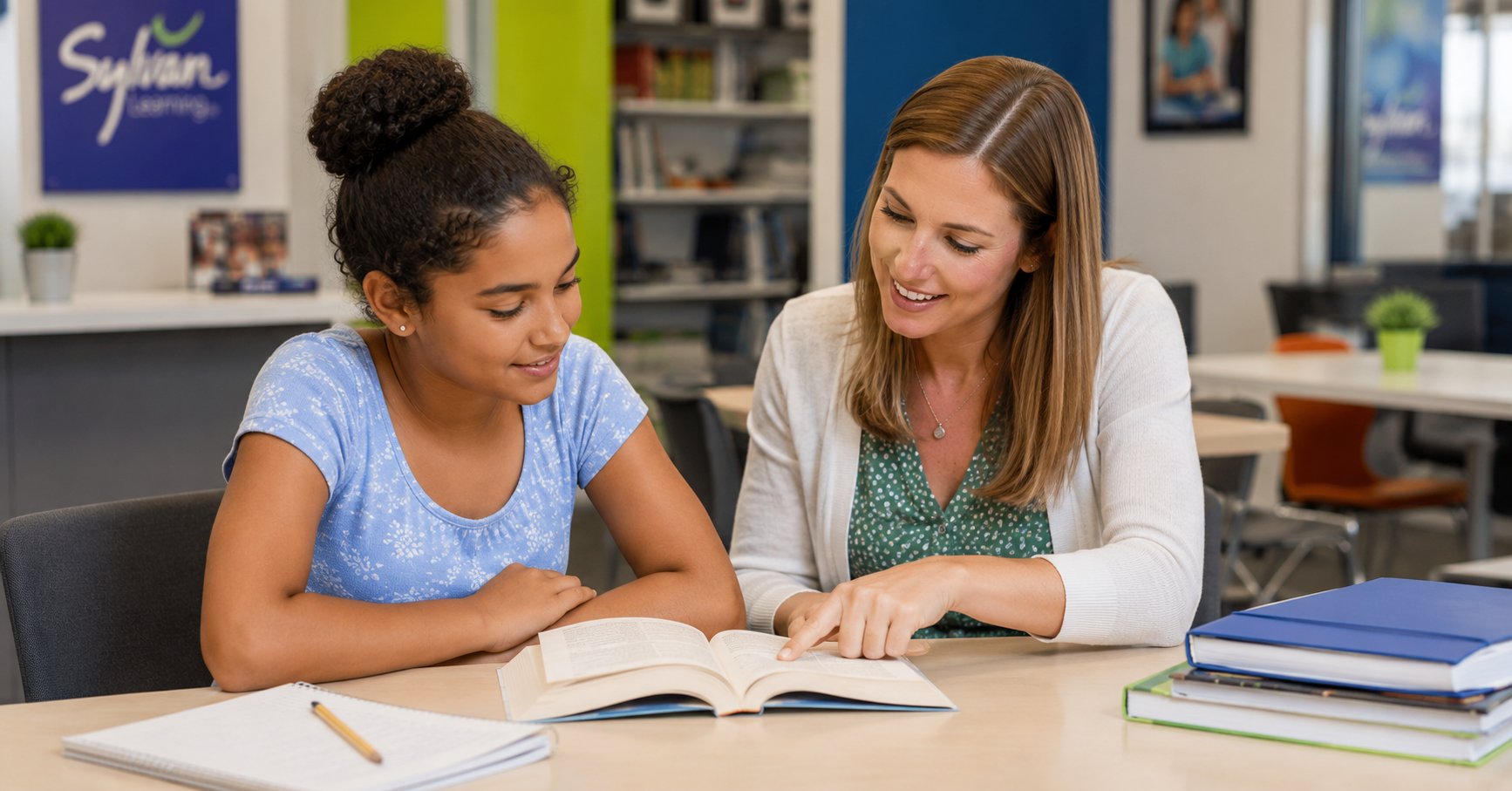
Sylvan Learning Camden provides reading instruction that starts from your child’s actual reading level, rebuilding comprehension, fluency, and the confidence that comes from reading without struggle.
When reading feels hard, children start to avoid it. The right instruction turns that around.
Start strong this fall with a personalized plan built around your child's actual level, needs, and pace.
Explore Our Programs →
Reading instruction at Sylvan begins with a careful assessment of the student’s actual reading level, including decoding skills, fluency, comprehension strategies, and vocabulary range. That level is often different from what the grade level suggests. A child who is behind grade level in reading needs instruction that starts where they are, not where the school calendar assumes they should be.
From the assessment, Sylvan builds a targeted plan focused on the specific skills the student needs most. For students with foundational gaps, that includes phonics and decoding work. For students who decode adequately but struggle with comprehension, instruction focuses on comprehension strategies, inference, and vocabulary in context. For students who have lost reading confidence, the plan also factors in the pace and approach that will help them feel successful as skills improve.
Sessions are led by credentialed teachers who provide live instruction and direct feedback. Progress is reviewed regularly with parents, with clear milestones tied to the learning plan.
For students who are still developing foundational reading skills, typically Kindergarten through early elementary, Sylvan addresses phonics and decoding first. The ability to connect letters to sounds reliably is the foundation everything else builds on. Students with gaps in phonics often struggle with fluency and comprehension not because they can’t understand ideas, but because the mechanical effort of decoding leaves little cognitive space for comprehension.
For students beyond the foundational stage, instruction focuses on reading fluency (reading accurately at an appropriate pace), reading comprehension strategies (identifying main ideas, summarizing, inferencing, distinguishing fact from opinion), and vocabulary development in context. Vocabulary is built from passages students actually read, not isolated lists.
Students who are behind grade level often carry a sense of shame about reading. A patient instructor who works one-on-one with them, at their actual level, without comparison to classmates, is often what creates the shift in both skill and confidence.
Sylvan’s reading instruction also addresses foundational early literacy skills when the assessment reveals a gap: phonological awareness (the ability to recognize and work with the sounds in words), spelling patterns, and sight word recognition. These skills form the foundation of fluent reading. A student who decodes slowly, or who guesses at words rather than sounding them out, often has a gap in one of these areas. Identifying and addressing that gap directly, not just providing more practice at the current level, is what allows real progress.
Parents often notice reading challenges in specific ways. A child who avoids reading aloud, guesses at unfamiliar words, or reads so slowly that comprehension disappears by the end of a passage is showing signs that direct reading instruction would help. A child who can decode the words but cannot explain what they read, who reads without retaining comprehension, needs a different kind of support.
Other patterns are subtler: a student who is strong in math but struggles with word problems, or who does well on verbal tests but underperforms on reading-based assessments. These patterns often trace back to reading skills that are not as strong as other indicators suggest.
For students who are already behind grade level, the most important thing is to start instruction at their actual reading level, without making them feel embarrassed about it. Sylvan’s one-on-one format protects that, and the patient instructors at Camden are experienced with students who have had negative experiences with reading in the past.
Parents considering reading support often compare several options before deciding. Here is what to know about each approach.
App-based programs, IXL, Lexia, Reading Eggs, and similar tools, can reinforce skills through digital practice, but they follow grade-level or algorithm-determined sequences that may not match your child's actual reading level or specific gaps. There is no credentialed teacher, no live feedback on how the student is reading, and no structured parent progress reviews. Sylvan instruction is human-led, starts from a real diagnostic of your child's level, and adapts as the student progresses.
School reading specialists work within class-size and scheduling constraints that limit individual attention. Many families are already on a waiting list for school-based support, or have found the pace too slow or the groups too large to address their child's specific gaps. Sylvan instruction is built around your individual child, targeted to their specific reading gaps, moving at their pace, with no group to accommodate.
Private reading tutors vary significantly in training, credentials, and approach. Without a formal assessment framework, instruction often focuses on whatever homework is in front of the student rather than the foundational skills driving the difficulty. Sylvan starts with a comprehensive diagnostic and builds a targeted reading plan from the results, so instruction addresses the root cause, not the surface symptom.
Programs like Kumon include a reading track, but instruction follows the program's proprietary sequence, not what your child's school is covering or what assessment shows they need most. A student with a specific comprehension gap must wait for the sequence to reach comprehension. Sylvan's instruction starts where your child needs to start, on the first session, no prerequisite steps in a program's internal sequence.
Sylvan Learning of San Jose – Camden works with students from all local schools, public and private, elementary through high school. See all the schools we serve →
Sylvan Learning Camden works with students starting in Kindergarten. For the youngest readers, instruction focuses on phonics, letter-sound relationships, and the foundational skills that set the stage for everything that follows. Early intervention in reading is one of the most impactful investments a family can make.
School reading instruction is paced for the whole class. Sylvan instruction is paced for your child, starting from their actual reading level and moving forward from there. A student who needs phonics work gets phonics instruction. A student who needs comprehension strategies gets that. There is no group to keep pace with.
Yes. Reading comprehension underlies performance across nearly every subject, history, science, and social studies all require students to read texts and demonstrate understanding. Students who strengthen reading comprehension typically see benefits across their academic performance, not just in English class.
Most families notice meaningful progress within six to eight weeks of consistent sessions. Foundational skills, decoding and fluency, often improve relatively quickly with consistent practice. Comprehension and vocabulary take longer, but progress is measurable through regular director-led parent reviews.
Yes. Sylvan Learning Camden’s one-on-one format means your child works with a single credentialed instructor, at their own level, without comparison to classmates. The pacing is theirs, the instruction is theirs, and the experience is specifically designed to help students who have had difficult experiences with reading in a group setting. Many of the students who benefit most from Sylvan have exactly this background.
Yes, and this is a particular strength of Sylvan Learning Camden’s approach. Instruction starts from the student’s actual reading level, not just their grade-level expectation. A student who is behind receives instruction that addresses the real gap, whether that’s in phonics, fluency, comprehension, or a combination. The patient, one-on-one environment means there’s no pressure to keep up with classmates, and no embarrassment about working at a level that’s different from where the school places them. Progress comes when instruction is grounded in where the student actually is.
Start with a free consultation with the center director, no commitment, no pressure. If it’s a fit, a comprehensive academic assessment builds the personalized learning plan. Get in touch with Sylvan Learning Camden today.