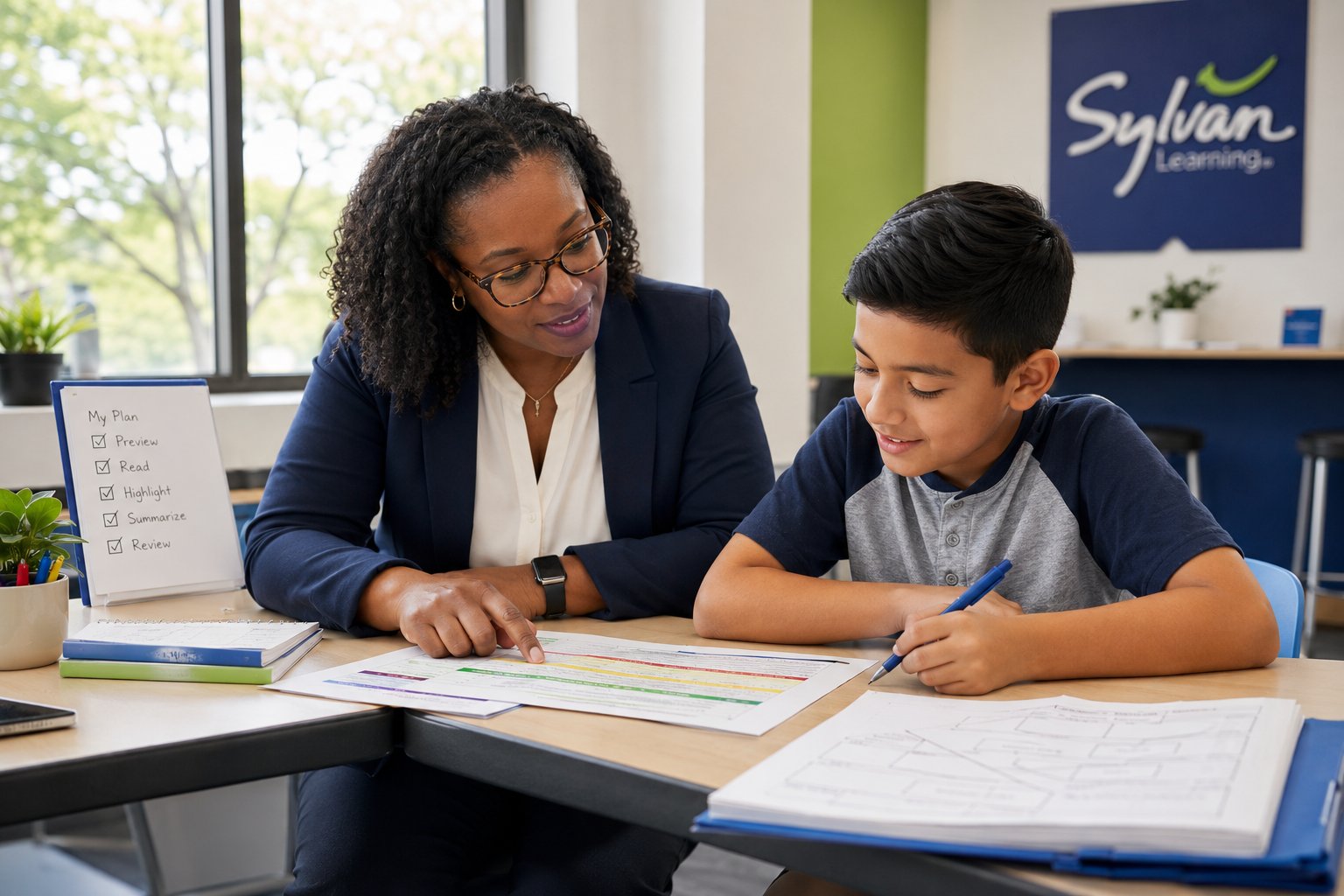
Sylvan Learning Westgate provides reading instruction that starts where your child actually is, not just where their grade level assumes they are, building comprehension, fluency, and vocabulary that lasts.
When a strong student is held back by reading, the right instruction unlocks everything else.
Start strong this fall with a personalized plan built around your child's actual level, needs, and pace.
Explore Our Programs →
Reading instruction at Sylvan begins with a careful assessment of the student’s actual reading level, including decoding skills, fluency, comprehension strategies, and vocabulary range. That level is often different from their grade level. A fourth-grader reading at a second-grade level and a fourth-grader reading above grade level both need instruction designed around where they actually are, not where the school calendar assumes they should be.
From the assessment, Sylvan builds a targeted reading plan focused on the specific skills the student needs most. For younger students who are still developing foundational reading skills, instruction includes phonics and decoding work alongside comprehension and fluency. For older students, instruction focuses more heavily on reading comprehension strategies, identifying main ideas, making inferences, analyzing text structure, and on vocabulary development in context.
Sessions are led by credentialed educators who provide live instruction and direct feedback, not passive listening or worksheet-based homework. Progress is reviewed regularly with parents, with clear milestones tied to the learning plan.
For students still building foundational reading skills, typically Kindergarten through early elementary, Sylvan addresses phonics and decoding first. Understanding the relationship between letters and sounds is the foundation that everything else builds on. Students who have gaps in phonics often struggle with fluency and comprehension not because they can’t understand ideas, but because decoding the words requires too much cognitive effort.
For students beyond the foundational stage, instruction focuses on reading fluency (reading accurately and at an appropriate pace), reading comprehension strategies (identifying main ideas, summarizing, making inferences, distinguishing fact from opinion), and vocabulary development. Vocabulary is taught in context, from passages students actually read, rather than as isolated lists to memorize.
Sylvan also addresses a dimension often overlooked: reading informational texts versus narrative texts. Academic success increasingly depends on a student’s ability to read textbooks, articles, and science passages with the same skill they might bring to a novel. Sylvan’s instruction covers both.
Sylvan’s reading instruction also covers foundational early literacy skills that are sometimes rushed or undertaught: phonological awareness (the ability to hear and work with the sounds within words), spelling patterns, and sight word recognition. These are not peripheral concerns, they are the underpinnings of fluent, confident reading. A student who hasn’t fully developed phonological awareness will struggle to decode unfamiliar words, regardless of grade. Sylvan’s assessment identifies whether these skills are solid, and instruction addresses any gap directly.
Parents often notice reading challenges in specific, observable ways. A child who avoids reading aloud, guesses at unfamiliar words rather than decoding them, or reads slowly enough to lose comprehension by the end of a paragraph is showing signals that foundational reading instruction would help. A child who reads the words correctly but can’t describe what they read, who reads without retaining comprehension, needs a different kind of intervention.
Other signs are subtler: a student who is strong in math but struggles with word problems, a student who performs well on verbal assessments but poorly on reading-based tests, or a student who comprehends when listening but not when reading. These patterns often trace back to reading skills that are not as strong as other indicators suggest.
Reading tutoring is also appropriate for students at or above grade level who want to develop stronger comprehension and analytical reading skills, particularly for middle and high schoolers preparing for reading-intensive coursework, standardized tests, or academic writing that requires synthesizing information from multiple sources.
Parents considering reading support often compare several options before deciding. Here is what to know about each approach.
App-based programs, IXL, Lexia, Reading Eggs, and similar tools, can reinforce skills through digital practice, but they follow grade-level or algorithm-determined sequences that may not match your child's actual reading level or specific gaps. There is no credentialed teacher, no live feedback on how the student is reading, and no structured parent progress reviews. Sylvan instruction is human-led, starts from a real diagnostic of your child's level, and adapts as the student progresses.
School reading specialists work within class-size and scheduling constraints that limit individual attention. Many families are already on a waiting list for school-based support, or have found the pace too slow or the groups too large to address their child's specific gaps. Sylvan instruction is built around your individual child, targeted to their specific reading gaps, moving at their pace, with no group to accommodate.
Private reading tutors vary significantly in training, credentials, and approach. Without a formal assessment framework, instruction often focuses on whatever homework is in front of the student rather than the foundational skills driving the difficulty. Sylvan starts with a comprehensive diagnostic and builds a targeted reading plan from the results, so instruction addresses the root cause, not the surface symptom.
Programs like Kumon include a reading track, but instruction follows the program's proprietary sequence, not what your child's school is covering or what assessment shows they need most. A student with a specific comprehension gap must wait for the sequence to reach comprehension. Sylvan's instruction starts where your child needs to start, on the first session, no prerequisite steps in a program's internal sequence.
Sylvan Learning of San Jose – Westgate works with students from all local schools, public and private, elementary through high school. See all the schools we serve →
Sylvan Learning Westgate works with students starting in Kindergarten. For the youngest readers, instruction focuses on phonics, letter-sound relationships, and the foundational reading skills that set the stage for everything that follows. Early intervention in reading is one of the highest-impact investments a family can make.
Classroom reading instruction is designed for the whole group, the pace and content reflect the average student in the class. Sylvan instruction is designed around your individual child, starting from their actual reading level and moving at their pace. A student who needs phonics work gets phonics instruction. A student who needs comprehension strategies gets that. There’s no group to keep pace with and no ceiling based on the class schedule.
Yes, reading comprehension underlies performance in nearly every subject. History, science, and social studies all require students to read texts, extract information, and demonstrate understanding in writing. A student who strengthens reading comprehension typically sees benefits across their academic performance, not just in English class.
Most families notice meaningful progress within six to eight weeks of consistent sessions. Foundational skill improvements, decoding and fluency, often show up relatively quickly with consistent practice. Comprehension and vocabulary development take longer but are measurable through the regular progress reviews the director conducts with parents.
For most students, yes, particularly older students who are comfortable with online learning formats. For younger students working on foundational phonics and fluency, in-center sessions are often preferred, as they allow the instructor to observe the student’s reading more directly. Ask the center director what format is recommended for your child’s specific situation.
Yes. Sylvan’s assessment establishes the student’s actual reading level, not just their grade-level expectation, and instruction starts from there. A student who is significantly behind receives instruction at the level where their skills are, building systematically forward. The one-on-one format means there’s no classroom comparison, no pressure to keep pace with peers, and no ceiling imposed by a grade-level sequence. Many of the families who benefit most from Sylvan reading instruction are working with students who have had difficult or discouraging experiences with reading up to that point.
Start with a free consultation with the center director, no commitment, no pressure. If it’s a fit, a comprehensive academic assessment builds the personalized learning plan. Get in touch with Sylvan Learning Westgate today.