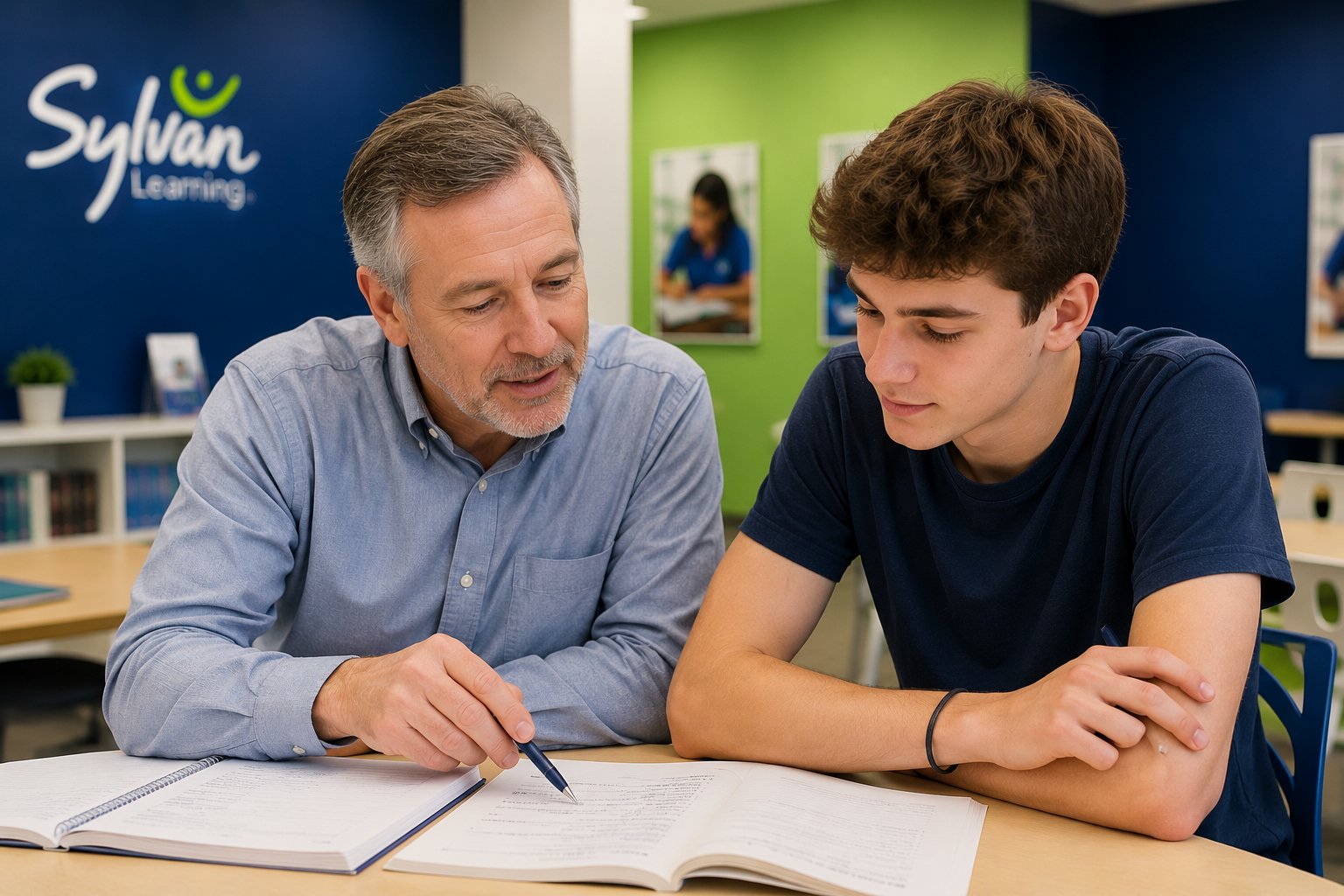
Sylvan Learning Westgate builds every test and competition prep plan around your child's current skills and target score.
From standardized tests to math and writing competitions, personalized teaching and credentialed instructors help your child perform their best on every challenge.
Start strong this fall with a personalized plan built around your child's actual level, needs, and pace.
Explore Our Programs →Sylvan Learning of San Jose – Westgate provides personalized, one-to-one test preparation — the SAT, ACT, PSAT, and AP exams, the private-school entrance exams (HSPT, ISEE, and SSAT), and readiness for math and writing competitions.
The HSPT is the entrance exam for Catholic high schools like Bellarmine College Prep and Archbishop Mitty; the ISEE and SSAT are used by independent schools like The Harker School.
Credentialed teachers build each plan from a diagnostic assessment of your child, so preparation concentrates on the sections that will move their result most.
Related: math tutoring (the foundation for SAT Math), the schools we serve, and summer programs for focused test-prep intensives.
Generic prep courses are built around the average student. Sylvan Learning starts from your child’s data instead:
Sylvan Learning Westgate prepares students for the full range of tests Bay Area families encounter, these and more:
One-on-one SAT preparation built from a diagnostic, taught by credentialed teachers — every plan is customized to the student.
Topics covered
Modes of instruction
Sylvan Westgate serves SAT-prep families across San Jose, Campbell, Cupertino, Saratoga, and Santa Clara. Every plan begins with a skills assessment, then a structured plan, ongoing progress tracking, and regular parent updates.
One-on-one vs. a group course. A group course moves every student through the same material at the same pace; a one-on-one plan spends time where your child can gain — the sections and question types most likely to move their score. For students already scoring in a strong band, that focus is what turns effort into points.
For competitions, see math and writing competition prep below.
Sylvan Learning supports readiness for a broad range of academic competitions, building the problem-solving, reasoning, and writing skills behind them, individualized and assessment-based, paced to the student. Example competitions we prepare students for include:
How prep works: the assessment sets the starting point, then instruction targets the specific skills each competition rewards, not a fixed syllabus. It runs alongside school coursework, so students build advanced skills without falling behind in class.
Group courses make every student cover the same material in the same order. Personalized prep creates a realistic plan to reach the target score:
Sylvan Learning of San Jose – Westgate works with students from all local schools, public and private, elementary through high school. See all the schools we serve →
Sylvan Learning Westgate prepares students for SAT, PSAT, ACT, HSPT, ISEE and SSAT, and AP exams, as well as school-level assessments that require structured preparation. The approach is the same for all of them: an initial assessment identifies the student’s current skills relative to the test’s demands, and instruction focuses on the specific gaps that will most affect the score or result. Ask the center director about your child’s specific test and timeline.
Catholic high schools in the Diocese of San Jose — including Bellarmine College Prep and Archbishop Mitty — use the HSPT, and students submit the one exam to several schools. Independent schools like The Harker School use the ISEE or SSAT (Harker accepts either). We prepare students for the specific exam and level their target schools require, starting from an assessment of where they stand on each section. Note that a few schools, such as BASIS, use their own admissions test — ask the center director about your child’s list.
Most families begin in the spring or summer before 8th grade, since the HSPT is typically taken in the fall of 8th grade. Three to four months of structured preparation is common for students who are academically on track; students with gaps benefit from starting earlier. Because instructional hours are tailorable, the plan can compress or extend to fit the test date.
Independent schools set their own application deadlines, most often between December and January, so families usually test in the fall — around October to December — which leaves room for a retake if a school allows one. The ISEE can be taken once per testing season (fall, winter, and spring); the SSAT is offered monthly. Confirm each target school’s deadline, then work back from it — starting prep a few months ahead gives time to close gaps before the first sitting. (Timelines vary by school and year — general guidance, not a fixed schedule.)
AJ Tutoring and C2 Education are established local test-prep providers. Sylvan’s approach is individualized and assessment-first: the plan is built around one student’s diagnostic, taught one-on-one by a credentialed instructor, with fully tailorable hours a family can weight toward whichever SAT sections need the work. For a side-by-side look, see our AJ Tutoring and C2 Education comparisons.
Yes. The diagnostic shows whether Math, Reading & Writing, or both need the most attention, and the plan is built accordingly. A student who is strong in math but needs work on the evidence-based reading section gets a plan weighted toward reading. Instruction is one-on-one with a credentialed instructor.
One-on-one. Group courses move every student through the same material in the same order; a personalized plan spends time only where a particular student can gain. Sessions are taught by credentialed instructors, in person (recommended) at the Westgate center, or online.
Both are accepted everywhere; the better fit depends on the student. The ACT includes a science-reasoning section and runs at a faster pace; the SAT allows more time per question. The center director can help you decide based on the assessment and a look at both formats, then build prep around whichever the student chooses.
Yes. Because instructional hours are fully tailorable, a family can schedule a focused SAT intensive in the weeks before a test date — any format, any intensity, built around the test date.
It depends on the test. For SAT and ACT, four to six months of structured preparation gives most students enough time to address foundational gaps and build test-specific skills, ideally starting the summer before junior year for fall or spring test dates. For HSPT and ISEE and SSAT, three to four months is typically sufficient for students who are academically on track; students with gaps may benefit from starting earlier. For AP exams, beginning in January or February for May testing is a common starting point. Earlier is almost always better, it creates room for the plan to adapt as the student progresses.
Score improvement depends on the student’s starting point, session consistency, and how much foundational work is needed. Sylvan provides a clear baseline from the initial assessment and tracks progress throughout the program. The center director will give you a realistic projection once the assessment is complete, based on your child’s actual starting point and your timeline, not a generic guarantee.
The HSPT, High School Placement Test, is used by many Catholic and private high schools in the Bay Area for admission and placement decisions. It covers verbal skills, quantitative skills, reading, mathematics, and language. Students typically take it in the fall of 8th grade. Sylvan can prepare students specifically for the HSPT’s format and content, beginning with an assessment of where the student stands on each section.
The ISEE (Independent School Entrance Exam) and SSAT (Secondary School Admission Test) are used by independent and private schools for admissions at the Lower Level (grades 5–6), Middle Level (grades 7–8), and Upper Level (grades 9–12). Both test verbal reasoning, quantitative reasoning, reading comprehension, and math. Sylvan prepares students for the specific exam and level they are taking, with an assessment-first approach that targets the sections where improvement will matter most.
Kaplan and Princeton Review are group courses with fixed curricula, the same content, in the same order, for every student. Sylvan builds a plan specific to your child’s current strengths and gaps. For a student with strong math but a gap in reading comprehension strategies, a personalized plan is significantly more efficient than six weeks of balanced group instruction. Credentialed instructors also teach directly, they do not supervise practice sets or review answer keys. The outcome is preparation that is targeted, not averaged.
That depends on the gap between the student’s current performance and their target, the test they are preparing for, and which sections need the most work. A focused six-to-ten-week program at two to three sessions per week is a common starting point. The center director will recommend a plan based on the initial assessment results and your timeline, with a realistic outlook on what is achievable in the time available.
Yes. Sylvan supports readiness for math competitions like AMC 8, AMC 10, AMC 12, Math Kangaroo, MATHCOUNTS, AIME, and Math Olympiad, plus essay and writing competitions, individualized and paced to the student, alongside school coursework. See the competition prep section above.
AoPS and RSM run group, curriculum-based programs. Sylvan’s competition preparation is individualized and assessment-based — instruction targets the specific skills a student needs for AMC, MATHCOUNTS, or another competition, paced to the student and run alongside school coursework. See our AoPS and RSM comparisons.
Prep centers like Elite Prep and Huntington Learning Center often run fixed-curriculum or group-based prep. Sylvan Learning builds the plan around your child’s specific gaps and target, taught one-on-one by a credentialed educator, targeted, not averaged.
Start with a free consultation with the center director, no commitment, no pressure. If it’s a fit, a comprehensive academic assessment builds the personalized learning plan. Get in touch with Sylvan Learning Westgate today.