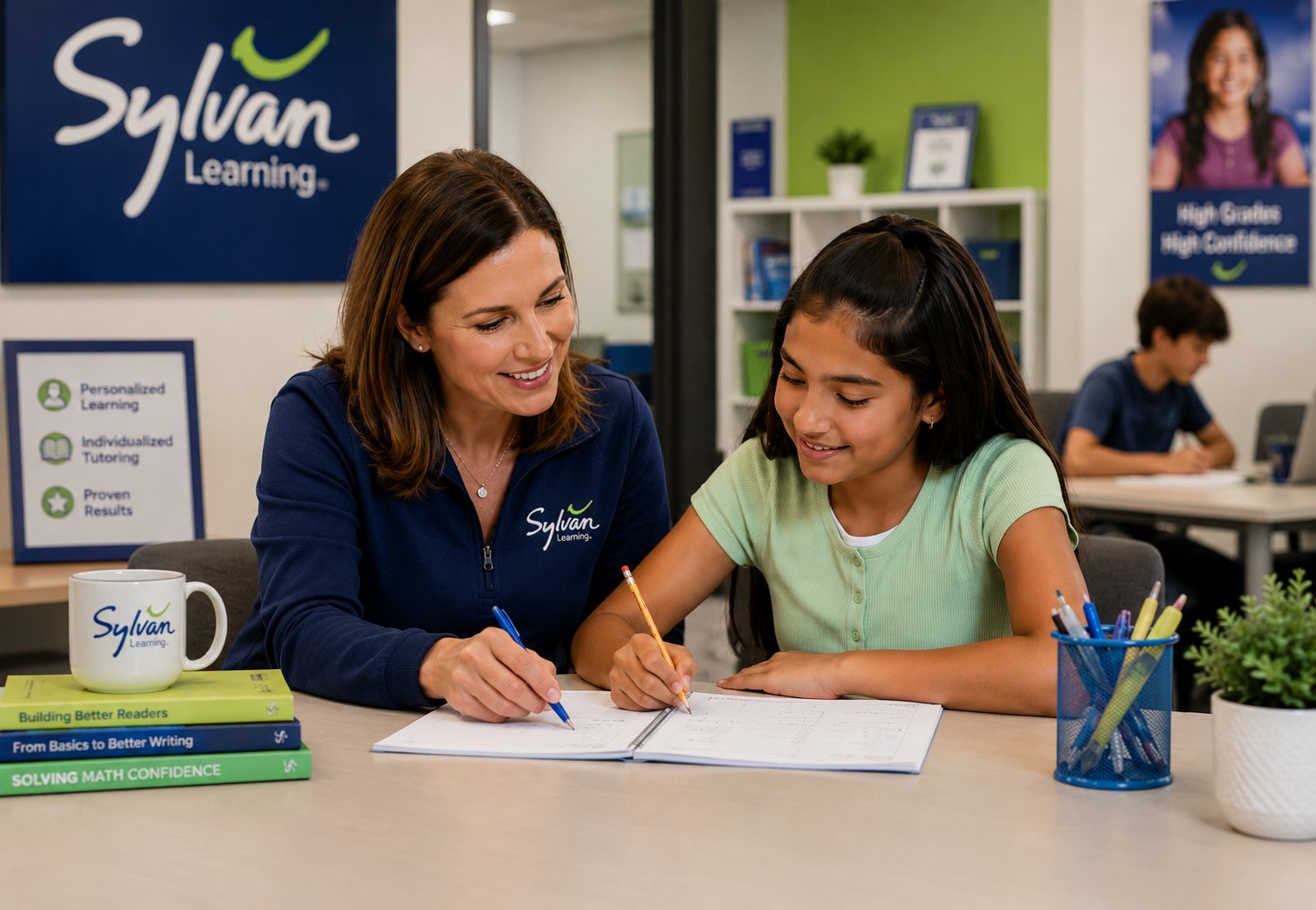
Sylvan Learning Westgate develops writing skills through essay-based instruction and direct teacher feedback — the foundation students need for AP English, research essays, and college applications in the Cupertino Union, Fremont Union High, Saratoga, and Campbell school districts.
When a strong student struggles under AP-level writing demands, the fix usually starts one level below the assignment itself — in structure, argument, and sentence-level control.
Start strong this fall with a personalized plan built around your child's actual level, needs, and pace.
Explore Our Programs →
Writing is a skill built through practice and feedback — specifically, meaningful feedback on actual writing from a teacher who can explain why something isn’t working and how to fix it. Sylvan Westgate’s writing instruction is structured around this principle. Students write, teachers respond with direct and substantive feedback, and students revise. Sessions are active and instructional — students are writing, discussing, and re-writing in real time.
Instruction begins with an assessment of the student’s current writing — how they structure an argument, develop ideas, express themselves clearly, and control sentence-level mechanics. From the assessment, the plan identifies the areas with the most impact. A Homestead or Lynbrook student with strong ideas but weak paragraph structure gets targeted instruction on essay organization. A student who struggles with vocabulary and mechanics receives targeted work in those areas.
This iterative, essay-based model mirrors the approach used in the most academically demanding classrooms across Silicon Valley. Students who go through it develop the critical thinking process that produces clear, organized writing across any subject — the same process an AP English reader, a college-essay reviewer, or an SAT Writing scorer is looking for.
Sylvan Westgate’s writing instruction covers the full range of written expression K–12 students need. For elementary students, instruction builds foundational written expression — sentences, paragraph structure, expressing ideas clearly and coherently. For middle school students, instruction moves into multi-paragraph essays, argument development, and writing for different purposes: narrative, expository, persuasive.
For high school students in Cupertino Union, Fremont Union High, Saratoga, or Campbell districts, instruction focuses on the more complex writing demands of AP courses — AP English Language, AP English Literature, AP History research essays — along with SAT and ACT written responses and college application essays. Vocabulary development is woven through instruction at all levels, learning words in context rather than through rote memorization, building the vocabulary range that distinguishes strong academic writing.
For 11th and 12th graders, Sylvan Westgate also provides direct instruction on college application essays — helping students articulate their experiences and perspective in writing that is genuinely their own, in a voice that reads as authentic to a selective-school admissions reader.
If your child is stepping into speech, debate, or forensics at a Cupertino, Saratoga, or Homestead high school — or you’re thinking about signing them up — strong writing is the foundation the coach will assume they already have. Organizing an argument, marshaling evidence, and expressing ideas precisely — the skills Sylvan Westgate builds in writing instruction — are exactly what carries a student on the stage or across the podium. A Sylvan assessment shows where their writing stands today, so the speaking and debate work sits on ground that holds.
Writing tutoring at Sylvan Westgate is a strong fit for students who avoid writing assignments — often not because they lack ideas, but because putting ideas into written form feels overwhelming or unclear. These students are frequently strong verbal communicators; instruction helps them translate that ability into effective written expression.
Students whose ideas are strong but whose execution is weak benefit particularly from Sylvan’s essay-based approach. Consistent feedback on actual writing — the kind an AP English teacher gives when they have the time — builds the connection between thinking and writing. Students who practice this iteratively carry the skill forward: into AP Lit, into a college application essay, into the writing that college itself will demand.
Writing tutoring at Westgate also serves students in high-stakes situations: AP English Language and AP English Literature exams, college application season, or standardized tests with written response components. For these students, Sylvan’s instruction is directly aligned to what the writing will be evaluated on — argument, evidence, clarity, and structure.
Parents exploring writing support often consider several alternatives. Here is an honest look at what each approach actually delivers.
Many tutoring programs teach writing through grammar drills, fill-in-the-blank exercises, and vocabulary lists. These build isolated mechanics without developing the ability to construct a clear argument or write under real conditions. Sylvan's instruction centers on actual writing, students produce essays and receive direct, substantive teacher feedback that develops both the mechanics and the thinking behind the writing.
Students increasingly use AI tools to draft or rewrite essays, which bypasses the learning process entirely. The student submits work without developing the underlying skill. Sylvan's approach is the opposite: students do the writing, and teachers respond with feedback that builds the ability to write independently. A student who learns to write doesn't need AI to write for them.
Private tutors vary significantly in credentials and approach. Most focus on session-by-session homework help without a formal assessment, learning plan, or structured progress reviews. Sylvan's writing instruction operates within a structured framework, assessment, personalized plan, director oversight, and regular parent progress reviews. The accountability structure is different in kind, not just degree.
Some tutoring centers offer writing through a preset curriculum that progresses at the program's pace, not the student's. A student who needs help with argument development works through whatever the sequence covers next. Sylvan's instruction is built around your child's specific writing level, gaps, and goals from the first session, and adjusts as those gaps close.
Sylvan Learning of San Jose – Westgate works with students from all local schools, public and private, elementary through high school. See all the schools we serve →
Sylvan Westgate provides structured writing instruction within a formal assessment-and-plan framework, with center-director oversight and scheduled parent progress reviews. An independent English tutor typically focuses on session-by-session homework help without a formal learning plan or progress tracking. The instructional method is also different — Sylvan is essay-based and iterative, with students writing, receiving substantive feedback, and revising, rather than working through grammar worksheets.
Yes. Sylvan Westgate’s writing instruction is built around the specific demands of AP-level coursework — the essay structure, argument development, and evidence-use skills that AP English Language, AP English Literature, and AP History reader-graders evaluate on. Instruction is aligned to how AP written responses are actually scored, which is the same framework students carry into college-level writing.
Writing is the vehicle through which students demonstrate what they know in almost every advanced high school course. AP History free-response, AP Biology experimental design, AP Psychology essays — all require the student to organize an argument, use evidence effectively, and express ideas precisely under time pressure. Students who develop general writing ability typically see downstream gains across their academic work, well beyond English class.
Writing progress at Sylvan Westgate is measured by comparing writing samples over time — looking at structure, argument development, vocabulary use, and mechanical control. The initial assessment provides a baseline. The center director reviews progress with parents at scheduled intervals and can show specific examples of how the writing has developed, drawing on actual work from the sessions themselves.
Yes. For 11th and 12th graders, Sylvan Westgate provides direct instruction on college application essays — helping students find their voice, structure their ideas, and produce essays that represent their strongest work. Because students in the Westgate program often apply to selective schools, instruction is calibrated to what these programs actually look for: clarity, specificity, and a genuine student perspective. Ask the center director about timing recommendations.
Start with a free consultation with the center director, no commitment, no pressure. If it’s a fit, a comprehensive academic assessment builds the personalized learning plan. Get in touch with Sylvan Learning Westgate today.